Quantum Challenge Party
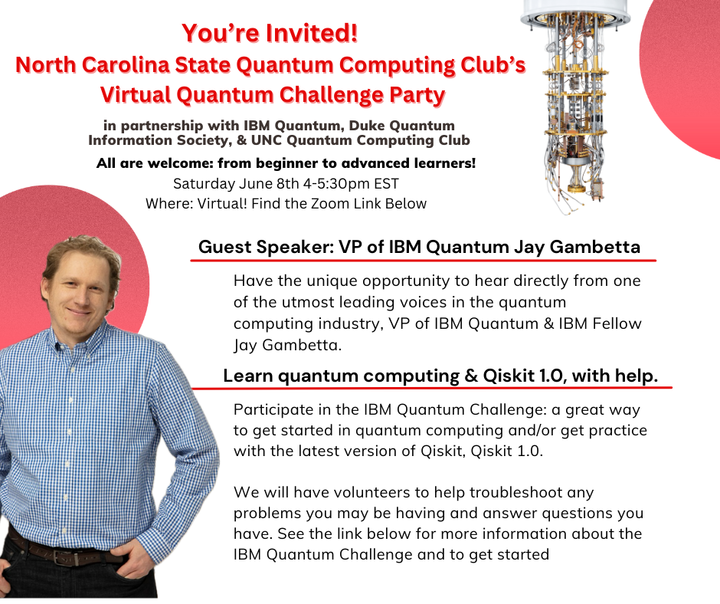
We are so excited to announce that North Carolina State University’s Quantum Computing Club will be hosting a virtual Quantum Challenge Party this Saturday alongside Duke’s Quantum Information Society and…
We are so excited to announce that North Carolina State University’s Quantum Computing Club will be hosting a virtual Quantum Challenge Party this Saturday alongside Duke’s Quantum Information Society and…

Please join the NC State Quantum Initiative, representatives from IBM, invited guests and our Quantum Innovation Center members for 2-full days of Quantum discussions at our 4th Annual Symposium. The…
Our weekly quantum computing seminar series returns Fall 2024. A virtual event is held every Friday at 2pm. See our speakers at the Quantum Seminar page. If you are not…
Hardware Security and the Future: Why Should You Care? The response to a security flaw typically goes through three phases: first, it is ignored, then it is acknowledged but claimed…
Abstract The nitrogen–vacancy (NV) quantum defect in diamond is a leading modality for magnetic, electrical, temperature, and pressure sensing with high spatial resolution and wide field-of-view, operating under both ambient…
Abstract Superposition, entanglement and nonlocality are the hallmarks of the quantum framework. In this talk, we consider the problem of reliable storage of quantum information with qubit rate below its…
Abstract The spin-boson model, involving spins interacting with a bath of quantum harmonic oscillators, is a widely used representation of open quantum systems that describe many dissipative processes in physical,…
Abstract The influence of information technologies such as the telegraph, personal computers, the internet, and artificial intelligence has been profound, driving significant global economic growth and creating substantial value. We…
Abstract One of the standard arguments for building a quantum computer is that we might profitably use the entanglements between qubits to simulate the correlations between electrons and thus solve a…
Abstract We will discuss experimental and theoretical progress towards large-scale error-corrected quantum computation. First, we report recent advances in quantum information processing using dynamically reconfigurable arrays of neutral atoms. Using…
Abstract Molecules have emerged as powerful instruments for conducting precise tests of fundamental symmetries, such as the search for the electron electric dipole moment (eEDM). However, molecules are generally difficult…